Other laws
FSSAI registration vs licence: which you need, fees and documents
From 1 April 2026, FSSAI registration covers turnover up to ₹1.5 crore. Which tier you need, the yearly fees, documents, FoSCoS steps and penalties.
Every food business in India needs an FSSAI certificate: basic registration if annual turnover is up to ₹1.5 crore, a state licence up to ₹50 crore, and a central licence above that. These limits apply from 1 April 2026; before then, registration stopped at ₹12 lakh. The government fee is ₹100 a year for registration, ₹5,000 for a state licence and ₹7,500 for a central licence, and certificates issued since 1 April 2026 don't expire while the yearly fee is paid.
What changed in 2026
FSSAI amended the Food Safety and Standards (Licensing and Registration of Food Businesses) Regulations, 2011 by a Gazette notification dated 10 March 2026, then set new turnover limits by an order of 13 March 2026:
- Higher limits from 1 April 2026. Registration up to ₹1.5 crore (was ₹12 lakh), state licence up to ₹50 crore, central licence above that.
- No renewals. A licence or registration issued on or after 1 April 2026 stays valid until suspended, cancelled or surrendered. The fee is still yearly.
- Street food vendors registered under the Street Vendors Act, 2014 count as registered with FSSAI, but must follow the basic hygiene rules.
- Risk-based inspections, so businesses with a clean record are inspected less often.
A state licence holder now within the registration limit moves across on FoSCoS by self-declaration, free and with the same number; the licence fee paid is set against the registration fee.
Who needs FSSAI registration or a licence
Section 31 of the Food Safety and Standards Act, 2006 bars anyone from running a food business without a licence, and lets petty food businesses register instead. That covers almost anyone who makes, stores, moves or sells food: home bakers, tiffin services, cloud kitchens, restaurants, shops, traders, distributors, transporters, warehouses, manufacturers, importers, exporters and online sellers.
Each premises needs its own registration or licence. A member making food at home for a self-help group or cooperative needs none of their own, if the group is registered or licensed with FSSAI.
Registration, state licence or central licence
FoSCoS's eligibility table, updated for 1 April 2026, uses turnover alone for most kinds of business. The old capacity tests, such as litres of milk a day, are gone.
| Tier | Annual turnover | Granted by |
|---|---|---|
| Basic registration | Up to ₹1.5 crore | Registering authority, state food safety department |
| State licence | Above ₹1.5 crore, up to ₹50 crore | State licensing authority |
| Central licence | Above ₹50 crore, and the businesses in the next section | FSSAI's central licensing authority |
Some kinds of business follow their own rules:
- Caterers have no registration tier: a state licence up to ₹50 crore, central above.
- Hotels go by star rating: five-star and above need a central licence, up to four-star a state licence. Hotels with turnover up to ₹1.5 crore can register.
- Clubs, canteens, dhabas, home-based canteens and food stalls have no central tier: above ₹1.5 crore they need a state licence.
- Grain, cereal and pulse milling units are listed for a state licence whatever their turnover; the FoSCoS eligibility check shows the tier for your unit.
Who always needs a central licence
Whatever the turnover, FoSCoS lists these for a central licence:
- importers of food;
- e-commerce operators, at the head office address;
- the head or registered office of a business with food premises in two or more states;
- merchant exporters, manufacturer-exporters and 100% export-oriented units;
- makers of proprietary food, health supplements and nutraceuticals, non-specified foods and ingredients, and Ayurveda aahara, and units that irradiate food;
- all food businesses at airports and seaports, and storage, wholesale and retail on central government premises.
A business in several states needs the head office licence plus a registration or licence for each unit, based on that unit's own turnover. Sellers on an online platform take whichever tier their own business fits, and their invoices show both their FSSAI number and the platform's.
FSSAI licence fees
FoSCoS's fee table, updated on 1 April 2026, shows the government fee per year:
| Certificate | Fee per year |
|---|---|
| Basic registration | ₹100 |
| Registration for hawkers (since 28 September 2024) and anganwadi centres (since 12 March 2025) | Nil |
| State licence | ₹5,000 |
| Central licence | ₹7,500 |
| Railway station caterers; catering in central government establishments | ₹2,000 for a central licence, ₹100 for a central registration |
| Duplicate certificate | 10% of the annual fee |
Many websites still quote ₹2,000 to ₹5,000 for a state licence, from the 2011 fee schedule; FoSCoS's 2026 table lists ₹5,000 for every kind of business. The portal shows the exact fee before you pay.
How many years. Before 1 April 2026 you chose a term of 1 to 5 years and paid for it upfront. Certificates issued since then have no term: FSSAI's March 2026 FAQs let you pay the yearly fee for several years at once, at any time of year, and the FoSCoS fee page offers up to five. Five years costs ₹500 for registration, ₹25,000 for a state licence and ₹37,500 for a central licence.
Documents for FSSAI registration
FoSCoS asks for your photograph, a government photo ID (such as Aadhaar, PAN or a voter ID) and proof of the business address if it differs from the ID. In Form A you also declare that you follow the basic hygiene rules in Schedule 4 of the Regulations.
Documents for a state or central licence
FSSAI's order of 19 March 2021 sets five documents for every licence:
- a list of proprietors, partners or directors with addresses, nominating an authorised signatory, on letterhead;
- their photo ID and address proof;
- proof of possession of the premises, such as a sale deed, rent agreement or electricity bill;
- the partnership deed, MOA and AOA, or a self-declaration for a proprietorship;
- Form IX, nominating a person responsible for compliance (not for a proprietor).
| Activity | Extra documents |
|---|---|
| Restaurants, hotels, canteens | Water test report from a recognised lab if water goes into the food (a municipal water bill will do) |
| Importers | Import Export Code and a recall plan |
| E-commerce operators, head offices | Recall plan |
| Transporters | Vehicle registration numbers |
| Manufacturers | Layout plan, unit photographs, equipment list with capacity, water test report, recall plan; plus a milk sourcing plan (dairy), municipal NOC (meat), the manufacturer's NOC (repackers, relabellers) or BIS licence (packaged drinking water) |
Self-attest each document before uploading it.
How to apply on FoSCoS
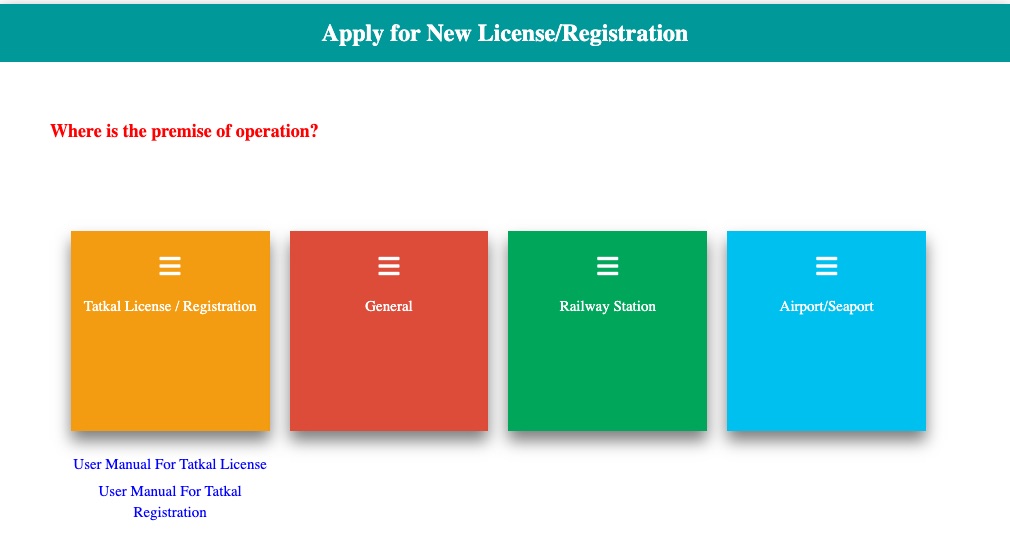 FoSCoS, New License / Registration: first choose where the premises are (General for most businesses), then the state and kind of business. Tatkal is for the lower-risk kinds that qualify. Our screenshot, 29 November 2026.
- On foscos.fssai.gov.in, run the eligibility check: pick your state and kind of business, and the portal shows the tier.
- Start a new licence or registration and fill Form A (registration) or Form B (licence): premises, food categories, products and contact details.
- Upload the documents and pay the fee online. Keep the application reference number.
- Answer any query within 30 days, or the application is rejected. FoSCoS lets you reopen one rejected only for a missed reply.
- Allow an inspection, if one is ordered.
- Download the certificate, with its QR code and 14-digit number. Registration numbers start with 2.
How long it takes
Registration. The authority must grant it, refuse it or order an inspection within 7 days, and decide within 30 days of ordering an inspection. If it misses either deadline you may start the business, though you must still make any improvements it later asks for. Since March 2026 the Regulations also allow instant registration on submission of documents, and FoSCoS issues instant (Tatkal) licences and registrations for some lower-risk kinds of business; the application shows whether yours qualifies.
Licence. The authority scrutinises the application within 15 days and may ask for more information, which you must give within 30 days. The licence is due within 60 days of the application ID. If it isn't issued and no defect has been pointed out, you may start the business; section 31(4) of the Act gives the same right after two months.
Displaying your FSSAI number
- At the premises: the registration certificate, or a true copy of the licence, at a prominent place.
- On labels: packaged food shows the FSSAI logo and your number; registration holders print their registration number the same way.
- On bills: since 1 January 2022, the 14-digit number goes on cash receipts, invoices, cash memos and bills. GST e-way bills and other system-generated government documents are exempt.
Renewal and the annual fee
A certificate issued on or after 1 April 2026 needs no renewal. If the annual fee goes unpaid, or a due return isn't filed, it is deemed suspended: you can't carry on any food business until you pay or file, with any penalty due. Set a reminder for the date each year's fee falls due.
FSSAI's 2026 FAQs give perpetual validity to certificates issued on or after 1 April 2026 and don't say the same of older ones, so if yours was issued earlier, treat the printed expiry date as live and renew before it until FoSCoS shows otherwise. Under the old rules, a renewal filed in the last 30 days before expiry cost a licence (not a registration) ₹100 a day extra. After expiry, renewal stayed open for 180 days at three times the annual fee (days 1 to 90) or five times (days 91 to 180).
If you close the business, tell the authority in writing within 30 days and surrender the certificate. Fees aren't refunded.
Annual return in Form D-1
Licensed manufacturers (including repackers and relabellers), importers and manufacturer-exporters file Form D-1 on FoSCoS by 31 May for the previous financial year; the return for 2026-27 is due by 31 May 2027. Traders, restaurants and other licence holders, and all registration holders, don't file it.
The late fee is ₹100 a day, capped at five times the annual licence fee. Since March 2026, a missed return also means deemed suspension until it is filed with the late fee.
Penalties
- No licence. Running without a licence you need: imprisonment up to 6 months and a fine up to ₹5 lakh (section 63).
- No registration. Section 63 excludes petty businesses that only need registration; running without one can attract the general penalty of up to ₹2 lakh in section 58.
- Repeat offences. Twice the punishment, up to ₹1 lakh a day for a continuing offence, and cancellation of the licence (section 64).
- False information in an application or return: up to ₹10 lakh (section 61).
What Indtaxes charges
| Service | Fee |
|---|---|
| FSSAI basic registration: eligibility check, Form A, filing on FoSCoS, query replies | ₹999 + ₹180 GST = ₹1,179 |
| FSSAI state or central licence: choice of tier, Form B and documents, query replies, inspection checklist | From ₹3,999 + ₹720 GST = ₹4,719 |
| FSSAI's own fee | At actuals, paid on FoSCoS |
A new food business often needs GST registration too, and small ones can take Udyam registration for MSME benefits.
Frequently asked questions
Is an FSSAI certificate the same as an FSSAI licence?
People use "FSSAI certificate" for both. Small businesses get a registration certificate; larger ones get a state or central licence. Both carry a 14-digit number.
What is the FSSAI registration limit in 2026?
Annual turnover up to ₹1.5 crore, from 1 April 2026; it was ₹12 lakh before. Above ₹1.5 crore you need a state licence, and above ₹50 crore a central licence.
Do I need FSSAI registration to sell homemade food?
Yes: registration up to ₹1.5 crore of turnover and a state licence above that. The exception is a member making food for a self-help group or cooperative that is itself registered or licensed.
Does a cloud kitchen need a central licence?
Not usually. A cloud kitchen counts as a restaurant: registration up to ₹1.5 crore, a state licence up to ₹50 crore. Delivery apps, as e-commerce operators, hold their own central licence.
How much does an FSSAI licence cost for five years?
In government fees, ₹25,000 for a state licence and ₹37,500 for a central licence; registration costs ₹500. A professional's fee, plus GST on it, is extra.
Last reviewed: 28 November 2026.
Sources
- FSS (Licensing and Registration of Food Businesses) Amendment Regulations, 2026, Gazette notification of 10 March 2026: https://egazette.gov.in/WriteReadData/2026/270872.pdf
- FSSAI order of 13 March 2026, revised turnover thresholds from 1 April 2026: https://www.fssai.gov.in/upload/advisories/2026/03/69b4054bb6cd6Order%20dated%2013thMarch2026_Revised%20Turnover%20threshold.pdf
- FSSAI order of 27 March 2026, FAQs on the 2026 amendment: https://fssai.gov.in/upload/advisories/2026/03/69c6a23234827order_27032026.pdf
- Ministry of Health and Family Welfare press release of 13 March 2026, FSSAI reforms: https://fssai.gov.in/upload/uploadfiles/files/Press%20Release_FSSAI%20Reforms_130326.pdf
- FoSCoS, kind of business eligibility and fee table (updated 1 April 2026): https://foscos.fssai.gov.in/assets/docs/Revised_2ndApril2026KindofBusinessEligibility.pdf
- FoSCoS, fee structure page: https://foscos.fssai.gov.in/fee/SL
- FoSCoS, FAQs on licence and registration: https://foscos.fssai.gov.in/faqs-license-registration?faqType=LR
- FoSCoS, documents required for a registration certificate: https://foscos.fssai.gov.in/assets/docs/DocumentsrequiredforRegistrationCertificate.pdf
- FSSAI order of 19 March 2021, documents for a licence by kind of business: https://foscos.fssai.gov.in/assets/docs/DocumentListMarch.pdf
- FSS (Licensing and Registration of Food Businesses) Regulations, 2011, FSSAI compendium: https://www.fssai.gov.in/upload/uploadfiles/files/Compendium_Licensing_Regulations.pdf
- FSSAI orders of 8 June and 30 September 2021, FSSAI number on bills from 1 January 2022: https://fssai.gov.in/upload/advisories/2021/10/6156936ac80bbOrder_License_Number_Print_01_10_2021.pdf
- FoSCoS, Form D-1 annual return format: https://foscos.fssai.gov.in/assets/docs/Form%20D_Annual%20Return_FY%202023-24.pdf
- Food Safety and Standards Act, 2006, sections 31, 58, 61, 63 and 64 (FSSAI copy): https://fssai.gov.in/upload/uploadfiles/files/FOOD-ACT.pdf
General information, not advice on your situation. Check the official text before you act.


