Income Tax
Advance tax payment 2026-27: due dates, who pays and late interest
Who must pay advance tax, the 2026-27 due dates, interest for paying late under the Income-tax Act, 2025, and how to pay online through e-Pay Tax.
Advance tax is income tax paid in instalments during the year, instead of all at once when you file. You must pay it if your tax for 2026-27, after TDS and TCS, will be ₹10,000 or more: 15% by 15 June, 45% by 15 September, 75% by 15 December and the rest by 15 March, or all of it by 15 March on the presumptive scheme. Pay late or too little and simple interest of 1% a month runs on the shortfall.
Advance tax under the Income-tax Act, 2025
The Income-tax Act, 2025 replaced the 1961 Act from 1 April 2026, so advance tax for tax year 2026-27 (April 2026 to March 2027) is paid under the new Act. The rules are in sections 403 to 410 (old sections 207 to 219), and the interest in sections 424 and 425 (old sections 234B and 234C). The ₹10,000 limit, the interest rates and the four due dates are unchanged. On the payment portal you now choose the 2025 Act and a tax year, not an assessment year.
Who must pay advance tax
Section 404 (old section 208) makes advance tax payable when the tax for the year comes to ₹10,000 or more. Under section 405 you estimate the year's income, work out the tax at this year's rates and subtract the TDS and TCS that will be deducted or collected during the year. What is left is your advance tax. In practice it catches:
- employees with rent, interest, dividends or capital gains that salary TDS doesn't cover;
- freelancers and professionals whose clients don't deduct TDS;
- businesses, whether proprietors, firms, LLPs or companies;
- non-residents whose Indian income isn't fully taxed at source.
Who need not pay
- Resident senior citizens aged 60 or more at any time in the tax year, with no income from business or profession (section 403(3), old section 207(2)). Pension, interest, rent and capital gains don't affect the exemption.
- Anyone whose tax after TDS and TCS is below ₹10,000. Most employees with only a salary fall here.
If you aren't liable, any small balance is paid as self-assessment tax before you file, without advance tax interest.
Advance tax due dates for 2026-27
| Due date | Paid by then, in total | Presumptive scheme |
|---|---|---|
| 15 June 2026 | At least 15% | Nothing due |
| 15 September 2026 | At least 45% | Nothing due |
| 15 December 2026 | At least 75% | Nothing due |
| 15 March 2027 | 100% | 100% |
Section 408 (old section 211) sets these dates. The single March date is for those declaring income under the presumptive scheme in section 58(2): businesses with turnover up to ₹2 crore, or ₹3 crore if cash receipts are no more than 5% (the old section 44AD), and professionals with receipts up to ₹50 lakh, or ₹75 lakh with the same cash condition (the old section 44ADA). Goods carriage owners under the same section pay in four instalments.
Anything paid by 31 March 2027 still counts as advance tax for the year. It won't undo interest for a missed instalment, but it counts towards the 90% test below.
The next date is 15 December 2026, a Tuesday; the last is 15 March 2027, a Monday. See December 2026, March 2027 and the full compliance calendar.
Interest for paying late or too little
Both charges are simple interest, worked out on tax after TDS and TCS.
For each instalment short: section 425 (old section 234C). At each date, what you have paid is compared with the required share of the tax on the income you finally return:
| Instalment | Interest if short |
|---|---|
| 15 June | 3% of the shortfall against 15%, unless you paid at least 12% |
| 15 September | 3% of the shortfall against 45%, unless you paid at least 36% |
| 15 December | 3% of the shortfall against 75% |
| 15 March | 1% of the shortfall against 100% |
The 3% is 1% a month for three months. On the presumptive scheme only the March charge applies: 1% of whatever was unpaid on 15 March.
For not paying 90% by 31 March: section 424 (old section 234B). If the advance tax you paid by 31 March is less than 90% of your assessed tax (the tax on your income, less TDS and TCS), you pay 1% a month on the unpaid tax from 1 April 2027, with part of a month counted as a whole month. When you pay the balance as self-assessment tax, the interest stops on the amount paid.
Income you couldn't plan for. Section 425 interest isn't charged on a shortfall caused by capital gains, dividends, winnings from lotteries and games, or business or professional income arising for the first time, if you pay the full tax on that income in the remaining instalments, or by 31 March if none remain.
Filing late adds more. Section 423 (old section 234A) charges a further 1% a month on tax still unpaid after the return's due date, until you file. Self-assessment tax paid before the due date doesn't attract it.
Example 1: a salaried person with rent
Meera works for a company and lets out a flat. For 2026-27 she expects tax of ₹2,90,000 on her salary and rent. Her employer will deduct ₹2,10,000 from her salary, and her tenant deducts nothing. Her advance tax is ₹2,90,000 − ₹2,10,000 = ₹80,000.
| Due date | Total due by then | This instalment |
|---|---|---|
| 15 June 2026 | 15% = ₹12,000 | ₹12,000 |
| 15 September 2026 | 45% = ₹36,000 | ₹24,000 |
| 15 December 2026 | 75% = ₹60,000 | ₹24,000 |
| 15 March 2027 | 100% = ₹80,000 | ₹20,000 |
She missed June and September. If she catches up with ₹60,000 by 15 December and ₹20,000 by 15 March:
- June: ₹12,000 short × 3% = ₹360
- September: ₹36,000 short × 3% = ₹1,080
- December and March: on time, nil
- Section 424: 100% paid by 31 March, nil
Total interest: ₹1,440. So it pays to reach 75% by 15 December even after missing the earlier dates.
She pays nothing until she files on 20 July 2027.
- Section 425: ₹360 + ₹1,080 + (₹60,000 × 3% = ₹1,800) + (₹80,000 × 1% = ₹800) = ₹4,040
- Section 424: nothing paid in advance, so 1% a month on ₹80,000 for April, May, June and part of July, which counts as four months: ₹80,000 × 1% × 4 = ₹3,200
Total interest: ₹7,240, on top of the ₹80,000 tax, assuming she files by the due date.
She sells shares in November. Suppose instead that Meera paid June and September on time (₹36,000), then sold shares on 10 November with tax of ₹30,000 on the gain. She adds the whole ₹30,000 to her December payment: ₹24,000 + ₹30,000 = ₹54,000, a total of ₹90,000, above 75% of her new ₹1,10,000 (₹82,500). She pays the last ₹20,000 in March. Her June and September payments fell short only because of the gain, so no interest is charged.
Example 2: a professional on the presumptive scheme
Arjun is a self-employed architect. He expects receipts of ₹40 lakh, all by bank transfer, and declares 50% (₹20 lakh) as income under the presumptive scheme. His clients are mostly homeowners who don't deduct TDS. Say his tax for 2026-27 comes to ₹2,00,000, all due by 15 March 2027.
- He pays ₹1,50,000 by 15 March and ₹50,000 with his return on 25 July 2027. Section 425: ₹50,000 × 1% = ₹500. Section 424: ₹1,50,000 is 75% of ₹2,00,000, below 90%, so 1% a month on ₹50,000 for four months (April to July) = ₹2,000. Total interest: ₹2,500.
- He pays ₹1,80,000 by 15 March and ₹20,000 with his return. Section 425: ₹20,000 × 1% = ₹200. Section 424: ₹1,80,000 is exactly 90%, so nil. Total interest: ₹200.
Outside the scheme, the same tax would be due in running totals of ₹30,000 by 15 June, ₹90,000 by 15 September, ₹1,50,000 by 15 December and ₹2,00,000 by 15 March.
Our free advance tax calculator does these sums for your own figures.
How to pay advance tax online
Pay through the e-Pay Tax service on the income tax e-filing portal. Each payment starts with an online challan that gets a Challan Reference Number (CRN).
- Log in at incometax.gov.in and open e-File > e-Pay Tax, or use e-Pay Tax on the home page without logging in, entering your PAN and the OTP sent to your mobile.
- Choose Income Tax Act 2025 (for tax year 2026-27 onwards) and click New Payment.
- On the Income Tax / Corporation Tax tile, click Proceed.
- Select tax year 2026-27 and the minor head Advance Tax (100).
- Enter the amount in the tax breakup and continue.
- Choose a payment mode and pay. A CRN is valid for 15 days; for advance tax, one generated on or after 16 March stays valid until 31 March.
- Download the challan receipt from the Payment History tab. Keep its Challan Identification Number (CIN), BSR code and date for your return.
Without logging in, the portal first asks which Act the payment is under, then for your PAN and mobile number:
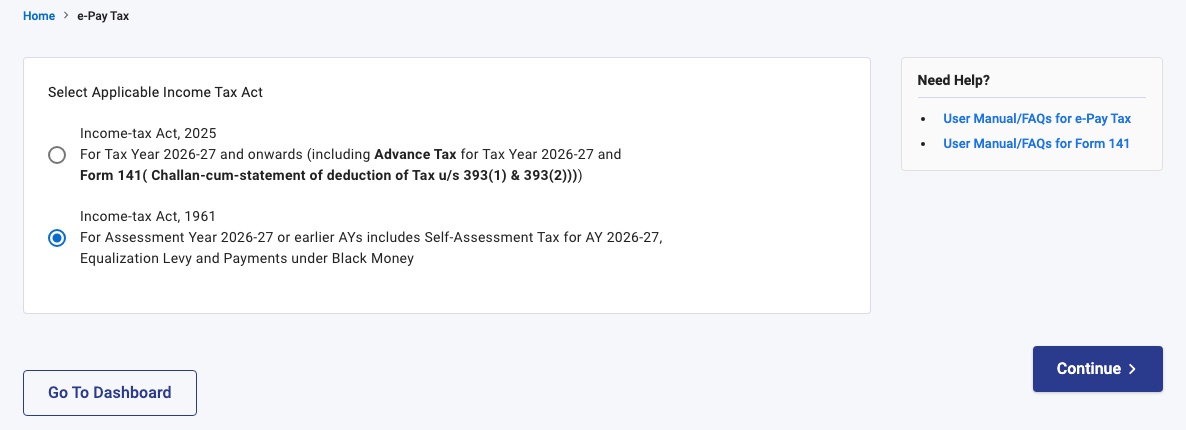 e-Pay Tax, first screen: choose the Income-tax Act, 2025 for tax year 2026-27, which includes advance tax. The 1961 Act is for assessment year 2026-27 and earlier. Our screenshot, 29 November 2026.
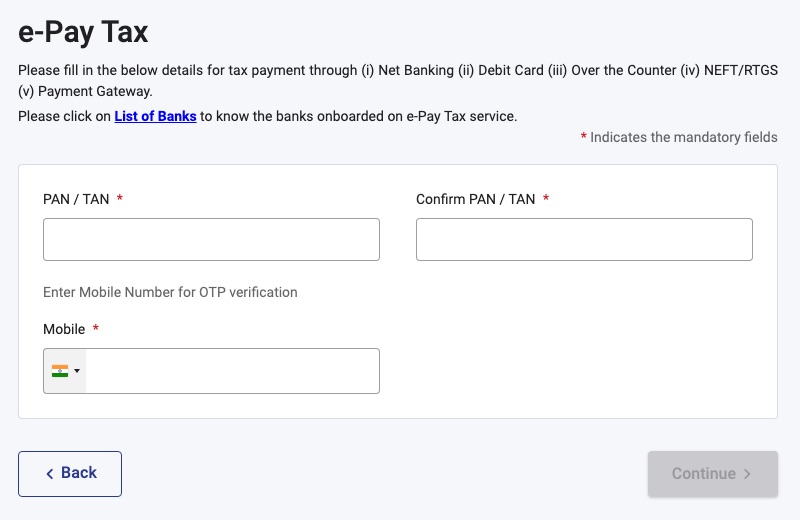 Next: your PAN, entered twice, and a mobile number for the OTP. After the OTP come the tiles and the tax year. Our screenshot, 29 November 2026.
Check the year and minor head before paying: the department doesn't refund or reverse a challan, and its credit is claimed in the return for the year you chose.
| Payment mode | What to know |
|---|---|
| Net banking | Authorised banks listed on the portal |
| Debit card | Canara Bank, ICICI Bank, Indian Bank, Punjab National Bank, State Bank of India or Union Bank of India; no charge |
| Payment gateway | UPI, credit cards, and debit cards or net banking of other banks; the gateway bank may add a fee plus GST, though the portal's FAQ says there is none on UPI or RuPay debit cards |
| RTGS/NEFT | Any bank, using the mandate form generated with the challan |
| Pay at bank counter | Cash up to ₹10,000, cheque or demand draft at an authorised bank; not for companies or anyone whose accounts must be audited under section 63 |
Checking the payment in Form 168 and the AIS
Form 168, the annual tax statement, replaces Form 26AS from tax year 2026-27; Form 26AS still covers years up to 2025-26. Log in and go to e-File > Income Tax Returns > View Form 168, which opens the TDS-CPC site, then choose View/Download Annual Tax Statement and tax year 2026-27. Your Annual Information Statement (AIS) also lists advance and self-assessment tax under Payment of Taxes. Match each entry with the CIN on your receipt before you file.
Paid too much, or too little
Too much. Claim all your advance tax in the return, and the excess comes back as a refund after processing. Under section 437, if you filed on time, the refund carries interest of 0.5% a month from 1 April 2027 until it is paid, unless it is less than 10% of your tax.
Too little. Pay the balance, with any section 424 and 425 interest, as self-assessment tax (minor head Self-Assessment Tax (300)) before you file, as section 266 (old section 140A) requires. A part payment goes first to any fee, then to interest, then to tax, so leaving out the interest leaves tax unpaid.
What Indtaxes charges
- Tax planning session: ₹2,499 plus ₹450 GST (₹2,949). A CA reviews your income and plans, works out your advance tax and gives you a written plan with dates.
- Income tax return filing: from ₹499 plus ₹90 GST (₹589) for salary income, or ₹1,499 plus ₹270 GST (₹1,769) with capital gains, including any interest and self-assessment tax worked out for you.
- Business and professional ITR filing: ₹1,499 plus ₹270 GST (₹1,769) on the presumptive scheme, or ₹3,999 plus ₹720 GST (₹4,719) with books, each with an advance tax estimate for the coming year.
Tax and interest are paid to the government at actuals.
Frequently asked questions
I only have a salary. Do I need to pay advance tax?
Usually not, because your employer deducts TDS each month. You need it only if the tax left after TDS will be ₹10,000 or more, for example because of rent or capital gains, or two employers in the year who each deducted too little.
Do NRIs pay advance tax?
Yes, if their tax in India after TDS will be ₹10,000 or more; the senior citizen exemption is only for residents. Much of an NRI's Indian income, such as NRO interest and rent, is taxed at source, so many have little left to pay in advance.
What if the due date is a holiday?
Online payment through e-Pay Tax works every day, so pay by the 15th and don't count on a later date. Neither remaining date this year falls on a weekend: 15 December 2026 is a Tuesday and 15 March 2027 a Monday.
Do companies pay advance tax?
Yes, on the same four dates. Companies and LLPs can't use the presumptive scheme, so they can't leave everything to 15 March, and companies can't pay at a bank counter.
Can I change my estimate during the year?
Yes. Section 406 lets you raise or lower the remaining instalments. Interest is based on the income you finally return, so raise the next instalment as soon as your income goes up: an early low estimate still costs interest for dates already passed.
Last reviewed: 29 November 2026.
Sources
- Income-tax Act, 2025, section 403, liability for advance tax and the senior citizen exemption (Income Tax Department): https://www.incometaxindia.gov.in/w/section-403-6
- Income-tax Act, 2025, section 404, the ₹10,000 limit (Income Tax Department): https://www.incometaxindia.gov.in/w/section-404-6
- Income-tax Act, 2025, section 405, computation of advance tax (Income Tax Department): https://www.incometaxindia.gov.in/w/section-405-6
- Income-tax Act, 2025, section 406, payment on your own estimate (Income Tax Department): https://www.incometaxindia.gov.in/w/section-406-6
- Income-tax Act, 2025, section 408, instalments and due dates (Income Tax Department): https://www.incometaxindia.gov.in/w/section-408-6
- Income-tax Act, 2025, section 58, presumptive taxation (Income Tax Department): https://www.incometaxindia.gov.in/w/section-58-144
- Income-tax Act, 2025, section 423, interest for late returns (Income Tax Department): https://www.incometaxindia.gov.in/w/section-423-6
- Income-tax Act, 2025, section 424, interest for default in advance tax (Income Tax Department): https://www.incometaxindia.gov.in/w/section-424-6
- Income-tax Act, 2025, section 425, interest for deferment of advance tax (Income Tax Department): https://www.incometaxindia.gov.in/w/section-425-6
- Income-tax Act, 2025, section 266, self-assessment tax (Income Tax Department): https://www.incometaxindia.gov.in/w/section-266-72
- Income-tax Act, 2025, section 437, interest on refunds (Income Tax Department): https://www.incometaxindia.gov.in/w/section-437-6
- FAQs on interest under sections 423, 424, 425 and 426 (Income Tax Department): https://www.incometaxindia.gov.in/documents/d/guest/faqs-on-interest-under-section-423-424-425-426
- Tax payments FAQ, including advance tax under the 2025 Act (e-filing portal): https://www.incometax.gov.in/iec/foportal/help/all-topics/e-filing-services/tax-payments-faq
- Tax payment modes under e-Pay Tax, user manual (e-filing portal): https://www.incometax.gov.in/iec/foportal/help/all-topics/e-filing-services/tax-payment-modes-under-e-pay-tax-UM
- Challan creation through PAN login, tiles and minor heads (e-filing portal): https://www.incometax.gov.in/iec/foportal/help/all-topics/e-filing-services/create-challan-pan-login-UM
- e-Pay Tax FAQs, CRN validity and challan receipts (e-filing portal): https://www.incometax.gov.in/iec/foportal/help/e-PayTax-faqs
- View annual tax statement, Form 168 and Form 26AS (Income Tax Department): https://www.incometaxindia.gov.in/tax-services/process-annual-tax-statement-e-filing-form-26as-form-168
- FAQs on the Annual Information Statement (e-filing portal): https://www.incometax.gov.in/iec/foportal/help/all-topics/e-filing-services/ais%20-%20annual%20information%20statement-faqs
General information, not advice on your situation. Check the official text before you act.


